Quality & testing
What does cold pressed mean?
The term is often used loosely. Here is what it should mean.
11 October 2026 · 3 min read
Cold pressed means the oil was extracted mechanically without heating the olive paste beyond a set temperature, and without chemical solvents. That is the short definition. What is more useful is understanding why it matters.
How olive oil is made
Olives are crushed — once with stone mills, now usually with metal grinders — into a paste. That paste is then stirred slowly in a step called malaxation, so small droplets of oil merge into larger ones. Finally the oil is separated from the water and solids, normally by centrifuge.
Every one of those steps can be hurried along with heat. That is the temptation.
Why heat gets used
Warming the olive paste releases more oil from the same amount of fruit. Commercially that is attractive: higher yield from the same raw material cost. But heat also breaks down the volatile flavour compounds, reduces polyphenols, and speeds up the reactions that raise acidity.
So a producer makes a choice: more oil, or better oil. Cold pressing is the second choice.
Speed matters more than people think
The moment an olive is picked, enzymes inside it begin breaking down the fats. That process does not pause while the fruit waits in sacks or crates under the sun. Every hour before pressing adds acidity, and acidity that has risen cannot be brought back down without refining.
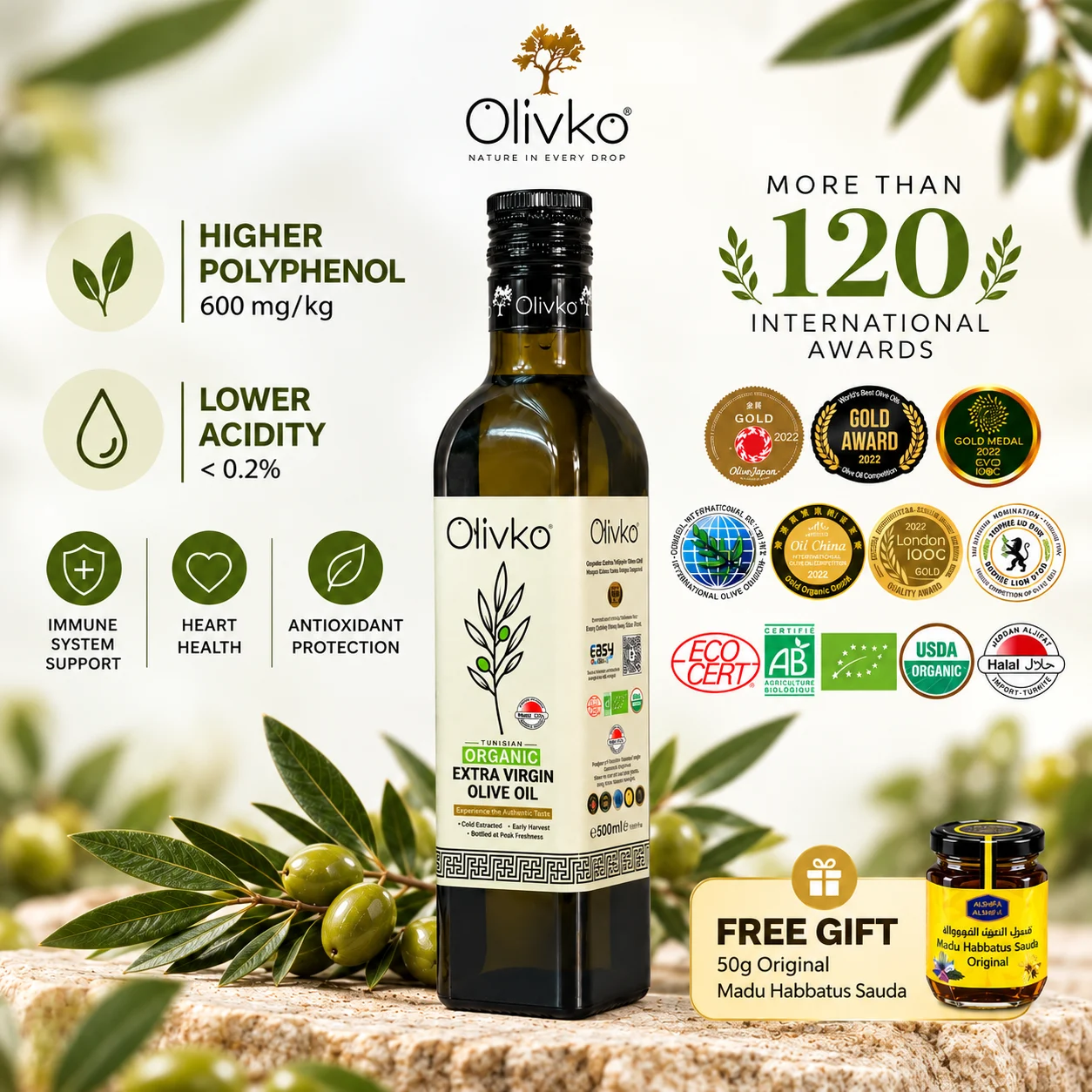
This is why the distance between grove and mill has a real effect on quality. Olivko is pressed within roughly three to four hours of harvest, which is part of why its acidity stays at 0.18% against an international limit of 0.8%.
The temperature it actually refers to
Under European Union rules, "cold pressed" and "cold extracted" refer to extraction below 27°C. That figure is not arbitrary — it is roughly the point at which the volatile flavour compounds begin to disappear noticeably.
The two terms mean slightly different things. "Pressed" refers to the older method using hydraulic presses and mats. "Extracted" refers to modern centrifugation, which is what most mills use today. Both are mechanical, and in terms of oil quality the gap between them is far smaller than the gap between warm and cold.
What happens to heat-processed oil
Oil extracted with significant heat, or with solvents, almost always has to be refined afterwards. Refining strips out flavour, smell and colour — and takes the polyphenols with them, the compounds that give fresh olive oil its peppery catch at the back of the throat.
The result is oil that tastes of very little. That is why bottles labelled "pure olive oil" or "light olive oil" taste close to neutral: they are largely refined oil, sometimes blended with a little extra virgin to put some flavour back.
There is nothing unlawful about that, and the oil is perfectly safe to eat. But it is a different product from extra virgin, and it should not be bought at an extra virgin price.
What to check on the bottle
- "Cold pressed" or "cold extracted" — but as a starting point, not as proof
- Free acidity given as a number, not as a claim
- A harvest date, not only an expiry date
- A single country of origin, not "blend of EU olive oils"
- Dark glass or a tin, because light damages oil however well it was pressed
"Cold pressed" with no numbers attached proves nothing, because the term is not uniformly enforced across markets. What proves it is the free acidity and polyphenol content on a laboratory report.